FemiCore › FemiCore ingredients
FemiCore ingredients
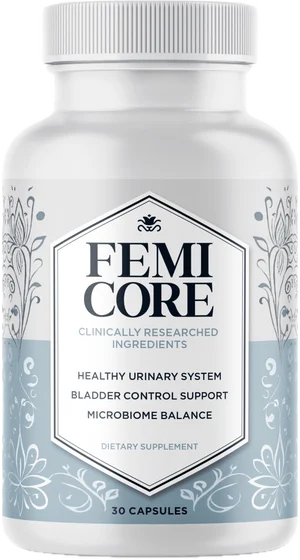
FemiCore contains nine active ingredients: four botanicals and five probiotic strains. Below is what each one is and why it suits a women's bladder formula. The exact amounts are printed on the Supplement Facts panel on every bottle.
The four botanicals
Mimosa pudica seed
The "touch-me-not" plant folds its leaves the moment they are brushed. Its seeds have been used in Ayurvedic practice for generations, and in water they form a soft, gel-like coating.
Bearberry leaf (uva ursi)
A low evergreen shrub whose leaves were a standby of European herbal practice for urinary comfort. The leaf naturally contains arbutin. Because of that, bearberry is traditionally taken in courses rather than indefinitely, a point to raise with your doctor if you plan long-term use.
Cranberry extract
The best-known fruit in urinary health. Cranberries are a rich source of proanthocyanidins (PACs), plant compounds that set cranberry apart from most other berries.
Berberine
A vivid yellow alkaloid found in barberry, goldenseal and Oregon grape. It has a long history in traditional Chinese and Ayurvedic herbalism and is now one of the most researched plant compounds.
The five probiotic strains
| Strain | Why it is included |
|---|---|
| Lactobacillus crispatus | Often the dominant species in a healthy female urogenital microbiome |
| Lactobacillus acidophilus | A familiar, well-studied probiotic found in cultured dairy |
| Lactobacillus plantarum | A robust strain common in fermented vegetables |
| Lactobacillus gasseri | A natural member of the female microbiome |
| Lactobacillus casei | A versatile strain that rounds out the blend |
How the ingredients work together
The formula is built in two layers. The four botanicals come from herbal traditions that have long been used for urinary comfort, from North American cranberry and bearberry to the berberine-rich plants of Asian medicine and the Mimosa pudica seed of Ayurveda. The five Lactobacillus strains bring the probiotic layer, aimed at the friendly bacteria that naturally dominate a healthy female urogenital microbiome. Taking both together in one capsule is simpler than buying a herbal product and a probiotic separately.
Quick reference
| Ingredient | Part used | Origin |
|---|---|---|
| Mimosa pudica | Seed | Tropical Americas, used in Ayurveda |
| Bearberry (uva ursi) | Leaf | Northern Europe, Asia and North America |
| Cranberry | Fruit extract | North America |
| Berberine | Root and bark compound | Barberry, goldenseal and related plants |
| Five Lactobacillus strains | Live cultures | Naturally found in the human body and fermented foods |
Ingredient questions
Why not cranberry alone?
Cranberry is the best-known urinary ingredient, but FemiCore is designed around the whole urinary microbiome, so it adds probiotics and three further botanicals.
Why so many Lactobacillus strains?
Different species of Lactobacillus are found in the female body. Covering five gives a broader blend than a single-strain product.
Are the ingredient amounts disclosed?
Yes. Each bottle carries a Supplement Facts panel with the amounts.
Is FemiCore vegan?
The ingredient list is plant-based and probiotic, but check the label on your bottle for the capsule material if this matters to you.
What FemiCore leaves out
The formula is described as non-GMO and stimulant-free, with no caffeine.
Ingredient cautions
- Avoid during pregnancy or breastfeeding unless your doctor approves, because of the berberine and bearberry.
- Ask a pharmacist if you take medicine for blood sugar, blood pressure or blood clotting.
- Get medical clearance for any probiotic if your immune system is weakened.
Further reading
- Urinary microbiome research update, Nature Reviews Urology (2019)
- Probiotics and women's urogenital health, Frontiers in Cellular and Infection Microbiology (2022)
- Mimosa pudica review, Evidence-Based Complementary and Alternative Medicine (2022)
Ready to order? FemiCore starts at $49 a bottle and is covered for 60 days after delivery.
Buy FemiCore